Category: Blogging & Online Media

  • Arriving Smarter: More Than 15 Ways to Get Busy During Dead Time

    london_underground
    Most of us spend at least an hour a day travelling; commuting to work by car, train, bus or flying somewhere for business. It’s time that’s often spent looking out of the window, texting mates or eyeing the cute guy/girl sitting across from you on the train. (Or if you’re travelling to London, wondering whether the leaves on the track are going to delay the train again…)

    It’s an hour or more that you should recuperate and use for your own benefits so here are a few suggestions for arriving smarter. [Credit to Christopher S. Penn for the “Arrive Smarter” theme & Tarek for pointing me to it originally.]

    Listen to an audio or video podcast

    Podcasts vary in quality, style, length and topics, so whatever you want to listen to, you should be able to find it. I tend to opt for a more focused podcast on the journey in; it wakes up the brain, gives some interesting ideas and motivation for the day. On the way home, I prefer the freestyle and slightly silly podcasts, which are sometimes informative, but always lighthearted.

    • TEDTalks video podcasts: TED offers some great food for thoughts from some fascinating people all over the world. Pick a topic you feel has little to do with your day job or industry and just listen. Some notable speakers for me have been Jill Bolte Taylor, Ze Frank and a number of people who spoke about creativity, imagination & education. [TEDTalks iTunes link]
    • BBC Radio 4 World of Business podcast
    • Heidi Miller’s Diary of a Shameless Self-Promoter: Brits tend to be much too self-deprecating and rubbish at self-promotion, so this one’s for you, my lovely limeys! Heidi’s podcasts cover a range of topics relating to promoting your business, yourself, and smart networking. [DSSP iTunes link]
    • Look for audio readings of Cory Doctorow‘s books, it’s always good to listen to.
    • Poke around the Podcasts section in the iTunes store and let me know what discoveries you make!

    Tip: If you’re an iPhone/iPod user, set it to automatically sync a few “most recent unplayed” podcasts through the options in the “Podcasts” tab in iTunes. That way, you’ll always have fresh stuff to listen to even if you haven’t had the time to pick podcasts manually before travelling.

    Pick a book that will help you towards your goals this year

    If you’ve picked a themeword for 2009, to help you drive your year forward, browse the web for a list of a few books, ebooks or research papers that will get you closer to your objectives. Or just pick a book to make you think, laugh or cry!

    Here are some of mine, to accompany my themeword “Impact” for 2009.

    • Tara Hunt‘s The Whuffie Factor, which will be published soon is on my must-read list
    • Cory Doctorow’s Down & Out in the Magic Kingdom is half holiday fiction, half social critique. I’ve already read it but definitely recommend it.
    • Dan Ariely’s Predictably Irrational is proving to be a good read on why and how we take certain actions, and how we may think we’re rational, we’re in fact predictably working on emotions or subconscious cues.
    • If you’re a productivity buff, you’ll know this guy, but if you’re new to it, you might enjoy Tim Ferriss’ 4-Hour Work Week. Or Leo Babauta’s The Power of Less (which will be available soon in the UK)
    • Sitting on my bookshelf for far too long is Charlene Li’s Groundswell is much overdue to be read.

    Keep offline reading material handy on your computer

    If you’re the type who uses a laptop on the commute in, you may not always have the luxury of an Internet connection so when you find interesting PDF ebooks, stick them in a “To read” folder on your desktop to dig into when you’ve next got some spare time.

    Alternatively, if you’re into that dead tree printing stuff,  carry a hard copy if you really must, but use the reverse side of paper you used before, or recycle the paper later by either giving it to someone else you feel would benefit or by chucking it in the recycling bin.

    A few great ebooks:

    • Leo Babauta from Zen Habits (same guy as above) recently published an ebook called Thriving on Less, which is rather appropriate in this year where much of our usual habits need to be re-examined to avoid excessive spending and keep us afloat through tough times.
    • 37 Signals’ Getting Real: While I don’t really go for the 37S Koolaid, I must admit it contains some great tips for working with small teams and producing quality apps.
    • Seth Godin’s Flipping the Funnel may be nearly 3 years old but it remains very relevant. Seth has created a number of ebooks over the years, so why not browse his site and download a few?
    • Chris Brogan wrote Using the Social Web to Find Work is highly relevant in this era of job uncertainty. A worthwhile read.
    • Finally, not so much an eBook but rather a Slideshare presentation you can download: Chrystie Corns, Social Marketing Manager at Where.com created a cracking presentation giving insight into what it’s like to tweet, blog and use social networks for a living.

    Make a conscious effort to relax

    Not interested in any of the above and prefer to snooze or stare out the window on your way into work? That’s fine, in fact, it’s great! Your brain needs that restful time. But let’s do a deal, if you’re going to go for zen, do it well.

    In other words, don’t let the train’s delay, the elbow in the ribs, the loud guy on his phone or the snow wrecking havoc piss you off. Take a deep breath and admire the glint of the sun on the buildings. Smile at strangers. Just enjoy the mental time off.

    [Image: Birdbath’s Piccadilly Filly (or 50 Things you never knew about London Underground) on Flickr, Creative Commons license]
  • RSS Feeds: Full Fat or Summaries?

    I love RSS and I hate RSS.

    It’s both one of the most useful tools I’ve ever used; it allows me to catch up with my favourite blogs, keep up with seldom-blogging friends and find inspiration for my own posts.

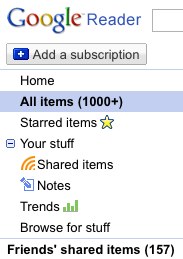
    google_reader-1It’s also the bane of my life; I turn away for a day or two and Google Reader sits there, laughing at me with its smug “1000+” in the toolbar, reminding me just how far behind I’ve fallen on my reading.
    Either way, it’s a way of consuming media that seems to have become routine so this morning, when I came to the realisation that I had just unsubscribed from my last summary-only RSS feed, I wondered if I was the only one to take such drastic action against those frustrating feeds, and wanted to understand why anyone would choose to publish them.

    I wrote about this topic 2 years ago with little conclusion so I thought I’d investigate informally whether things have changed by asking my Twitter followers.

    So what are their issues with the short summaries?

    The results were enlightening but roughly reflected what I expected; Out of 15 responses, 12 people expressed a strong preference for full feeds, to the extent where summary feeds were either not subscribed to or unsubscribed from.

    • Don’t want to click
    • Don’t want to be forced through to a site to read something
    • Full feeds get more readers and engagement
    • When using Google Reader on iPhone, RSS summaries are annoying. Clicking through is a waste of time
    • I never subscribe to anyone with summary-only feeds, why encourage them?
    • “Publications” opt for summaries to drive traffic and ad revenue
    • Summary on mobile sucks, don’t subscribe and probably forget to visit again
    • Would rather see a full feed with ads, than a summary feed

    One person seemed to stand up for the summary feed, saying that short post feeds are fine when reading basic news story while travelling. So that’s one for the summary feeds, but with the caveat that the summary must really summarise the story rather than simply be the first run-on sentence of a post where the author might not get to the point immediately.

    The publishers’ point of view

    Two publishers were kind enough to explain their side of the story; in both cases, it was a question of protecting their content against sploggers who previously stole their feeds on a regular basis. While summaries don’t fully solve the problem, it makes it more difficult for a spammer to copy their content.

    No one piped up with regards to summary feeds as a method to gain more traffic to the site, and more ad impressions as a result. Either that isn’t the motivation of most summary-feed publishers, or they’re aware that it isn’t a popular view and avoided responding to my question.

    Finding a solution

    Finding a solution to these publishers’ problem is tricky; it’s difficult to identify who is subscribed to your RSS feed and what they’re using it for. Feedburner makes a good effort of reporting “uncommon uses” of your feed, but in my experience it has picked up the legitimate uses of my feed (where I’ve used it on another site I own) but missed most instances of splogs “borrowing” my content.

    So if the flow can’t be stemmed, we need to make the flow smarter:

    • Add an automatic footer to a post in the RSS feed linking back to your site: Joost de Valk created a WordPress RSS footer plugin which takes care of the hard work for you.
    • Cross-link generously when writing your posts: Don’t go overboard and write purely for the purpose of linking back to your older content, as it’ll show in the quality of your posts. But when you do post, think of the relevant and useful content you could refer to, so that if your post is on someone else’s blog, there is still a reference to yours. This can be done within the content or as “related items” at the end of your post. Yes, some services or plugins can create related items automatically, but I don’t endorse those as I find the relevance to often be too poor. Take 5 minutes and do it manually!

    These benefit you from an SEO point of view as well, so why not put them into action? Remember, however, that creating value on your site and building your personal brand so that people recognise you as YOU rather than a generic blog-post churner is the best way to create a loyal readership and make the sploggers’ efforts (almost) pointless.

  • How Stephen Fry lost Britain hundreds of man-hours of work

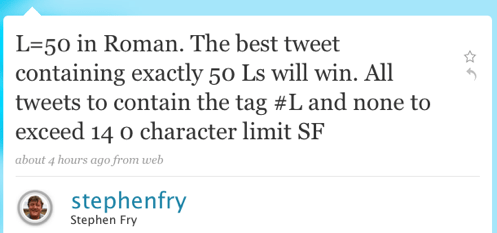
    Around lunchtime today, Stephen Fry, national treasure and Twitter celeb, announced that to celebrate having 50,000 followers, he would hold a challenge:

    stephen_fry_challenge

    He adds “There’s the competition in a nutshell below. Star it for reference. The prize will be good and sent anywhere in the world.”

    Now I’m not quite sure what makes Stephen’s challenge more viral than any other Twitter-led idea but it’s been spreading like wildfire. It could be:

    • Wanting to be recognised as clever by such a high profile personality
    • The lure of the prize (as of yet unknown)
    • The sheer madness of the challenge (Have YOU tried fitting 50 L’s in 140 characters?!)

    It’s fair to say that many man-hours were lost today whilst tweeters attempted to make up their own sentences. See for yourself on Twitter Search for the volume of inbound tweets to Stephen today.

    This challenge is particularly sweet because there are no strings attached, just a bit of fun with the potential for a fun prize picked by a discerning geek. However, if a brand were to use this format for a campaign, you know what… I probably wouldn’t be too adverse to it! What about you?

    And my attempt? I’m still failing because it’s far too long, but here’s what I’ve got so far: “Llewellyn’s llama lulled lamentably ill Lola’s lily & Lloyd lol’ed @ little Lola’s silly ballet flailing. Filling Lilly’s yellow lilo, he spells llastically: Billy tells & yells loyally”

    Blurgh!

  • WordPress & Akismet: Why It's Important to Mark Spam as Spam

    According to Spamhaus, over 96% of all email is spam. That leaves 2% for Facebook notifications, 1.5% for those forwards your mum sends you that you saw in 2001 anyways & about 0.5% for those nagging emails your boss sends on Sunday nights. It’s grim isn’t it? Yet we love it, and we (certainly I) couldn’t live without it.

    How about blog comments?

    Bucket and SpadeWe love getting recognition and fandom for the great entries we write, even though we might not get as many as the big blogs who might get a few hundreds for every post written! And how much spam in blogs? Well, according to Akismet, who power the spam filtering for WordPress and Movable Type blogs, 85% of all blog comments are spam.

    Recently, however, I’ve noted a slightly disturbing trend where bloggers let some spam comments through by choice. I’m mystified on why they would do this; ignorance that spammers can “customise” a spam message by including your post title and therefore assuming it’s real? Naivety that a comment like “I was searching for Blogs about personal government grant applications and found this site. I am interested in your content and appreciate sites like this.” could be a real one? Or a personal interest in wanting to see their posts appear to have more comments?

    Others seem to simply hit “delete” instead of “spam” in their WordPress admin area, since the immediate results are the same.

    But here is why it matters

    It’s important for us all to call a spade a spade and a spam comment a spam comment.

    Akismet is more than just a spam filter for YOUR blog, it’s a giant brain. Not the gooey, kept-in-a-jar kind of brain, don’t worry. (Though I wouldn’t put it past Matt Mullenweg to have one of those too…)

    It’s a system that learns from all our actions, so every comment you mark helps it identify ham from spam in the future on your blog, but also on every other Akismet user’s blog. So marking a commenter you don’t like as “spam” or a spam comment as “deleted” muddles the waters. Bet you didn’t realise it affected everyone else, did you?

    Follow these simple rules

    • If it’s a real comment from a squishy human user but you don’t agree with it, hit delete.
    • If it’s a comment from a bot, something that looks automatically generated or links to obvious spam sites, hit spam.

    Being consistent with these rules will allow us all to spend more time blogging and less time moderating comments. Meanwhile, if you haven’t got Akismet already enabled on your blog, what are you waiting for?

    [Image: Bucket and Spades by Auntie P on Flickr, under Creative Commons]

  • SocialMediaCamp London: A Look Back At The Many Themes

    Do you ever look back at past achievements and feel yourself swell with pride because, with hindsight, you now realise how well you and others did?

    This morning, poking around Flickr, I came across Tom’s photo of the schedule board at SocialMediaCamp London, which was back in October. We gathered 100 attendees, many of which chose to present on a topic of their choice, kicking off interesting conversations and collaborations amongst participants. Since I didn’t get to attend every presentation, some titles still puzzle me, but here is the full list of panel/presentation/discussion topics:

    socialmediacamplondon_schedule

    • How to write awesome headlines – Tom Whitwell, The Times
    • Social Media as Community Activism: From International Networks to a local perspective – Salford Social Media Centre
    • Love is in the air – Jonny & Jayme, Glue
    • How/Why Moderate Masses (180,000 users) – The Sun Online
    • Social Media: How Not To Get Fucked – Girl With a One Track Mind
    • How to Replace CNN with Something Nicer: IPTV
    • How Hedgehogs can Inspire Social Media – Carl @Fellowcreative
    • Entreprise Microblogging is More Than Twitter: A First Look at Brand New Microblogging System – Communote.com
    • Lifestreaming your Life Online – Ande Gregson & Paul Kane, Sky
    • Buzz Management For Startups: How to Build Workflow so Everyone Knows What’s Going On – Jure C
    • Relationship Counselling for PRs and Bloggers – Paul Borge
    • Legal Aspects of Social Media – Victoria McEvedy
    • Digital Yoga & The New Religion of the Web – Rohan
    • One (wo)man Social Media Empire-Life! – Lloyd Davis
    • Twitter for the Environment – Carmen
    • Man Boobs, Incest, Sarah Palin and The Times: How We Do SEO @ Times Online – Mariana Bettio
    • The Social Graph: Who Owns It? What Is It?
    • DIY PR: How to Get PR For Your Startup (Please Fire your PR Firm/Agency)
    • Native To a Web of Dudes – David Thompson
    • How to Present to Big Scary Companies (And Look Like You Know What You’re Doing) – Terence Eden, Vodafone
    • Alternate Reality Games
    • Social Media For Good: Respite For Carers, A Project in Development (Discussion)
    • We’re All Chemicals: Social Objects on the Social Web, Socialising – Dan Donald
    • 6 Degrees of Separation Now – Benjamin Ellis
    • Programmer-Journalists or Journalist-Programmers (Group Discussion) – Mark Ng
    • How to Use LinkedIn To Get a Better Job
    • TV III Branding: The Management Of Television Brands in The Digital Age – Will Prestes
    • Staying Pseudonymous On & Offline
    • Scrumping 2.0: A Model for Wider Community Involvement?
    • Digital Footprint
    • If you Work in Marketing or Advertising, Kill Yourself Now – Chris Applegate
    • Data Portability – Ben Godfrey
    • The Web of Babel: Managing Languages on the Web – Chrys
    • Akoha: The Social Reality Game – Emma Persky
    • Online Reputation Management: It’s Not All Bad
    • Ideas Into Action: Developing a Toolkit for Collaborative & Community Projects – Alison
    • Print & Online Social Media: Can You Make It Work? – The London Paper
    • Measuring Engagement of Social Media Websites in the Web 2.0 World
    • Managing Online Identity & Personal Brand – Vero Pepperrell
    • 7 Secrets to Facebook Fundraising
    • Blogging Breakdown & How to Avoid It – Annie Mole
    • Social Media Bingo Session

    A few presentation notes made their way on the SMCLondon blog and quite a few have been posted to Slideshare under the tag “smclondon08” so, if like me you want to reminisce, or didn’t have the chance to attend, have a look!

    I can’t help but wonder what trend similarities and changes we’ll see at SocialMediaCamp London v.2.0… Want to get involved in the second SMCLondon? Drop me a line as the planning is only just beginning and we always welcome an extra pair of hands!

  • You Gotta Have Faith: Taming Your Inner Critic

    grumpy_smallI came across Tara’s post here about taming her inner critic, where she questions her abilities at live interviews and doubts her own writing skills. I believe we all have moments like this. But some are worse than others…

    [I’m about to make a bold generalisation and some will have want my head off for making such a statement, but bear with me.]

    Since I moved from Canada, I have seen too many Brits or Europeans be very sheepish about self-promotion. American sales people are reputed to be bubbly, brash and bigger than life, speaking louder than anyone else in the room and gesticulating endlessly to illustrate what they’re saying. Quite at the other extreme, British marketing folks are often seen to be more reserved and self-deprecating.

    I think there are two aspects to this cultural difference;

    A lack of faith for the team or product

    In the US, in particular in buzzing centres like Silicon Valley and New York, the belief that a small nobody can become the Next Big Thing is encouraged and nurtured.

    In Europe and in the UK, too many people let themselves believe that they’re necessarily second fiddles in the game. This unfortunate attitude is perpetuated by sheltered Americans like Mike Arrington of TechCrunch fame, who base their views of an entire culture on a single event. I strongly believe that this perception is wrong, it isn’t about geographic location (mostly) but about what you do with your resources. Are you out there talking to prospects (in person and virtually) or somewhere in the deepest, darkest Midlands developing in your small office, assuming that because you put your app on the iTunes Store, it’ll market itself?

    As a promoter for your business, you aren’t Hugh Grant, and self-deprecating sweetness won’t get you there on its own. If you don’t sell yourself, nobody will do it for you.

    An assumption that the product speaks for itself

    Yes, a great product is 90% of the marketing effort. But unless people can find out about your product and feel their questions will be heard, you’re missing the first link of the chain, that first 10% of the effort that leads to the viral spread Holy Grail.

    So dust off your pencil and paper, write that press release about the latest features or the new team members and send it far and wide (but do it gracefully, of course!) Step outside of your comfort zone a little and be bold about what you do and love.

    That’s why folks like Whatleydude, Andrew J. Scott and many more* stand out from the crowd and sometimes can rub folks the wrong way by being more open and self-promoting than your average community or marketing person in the UK.

    So where is the widespread shrinking violet attitude coming from? Isn’t this the country that once reigned on history’s largest empire?

    I’m no historian or psychoanalyst so I’ll spare you the attempt at explaining it – Let’s leave it as a rhetorical question, shall we? When I’ve challenged the Brits around me about their unwillingness to stand up and be vocally proud of what they’ve created or their talent, I’ve received a range of answers;

    • Not self-promoting is a sign of humility
    • Casual is cooler, you have to look like you’re not trying too hard or you’ll be seen as a sell-out
    • We don’t like to shove our product in the users’ faces, if they want it, they’ll come to us
    • We don’t do press releases, it’s not in our ethos

    But that’s not how it works anymore, sorry to break it to you! There are too many products, too many services and too much noise in our lives. If you don’t promote what you love, people won’t magically discover it. The community manager, the marketing team, the PR folks, you’re all that first 10% of the chain. It’s your job to let people see that you’re passionate about what you’ve created. (And if you’re not, time to go jobhunt, innit?)

    Breaking the habit

    So here are my three top tips for those who want to come out of the proverbial shell and learn to feel good about their business:

    • Go sing karaoke, both in front of friends and strangers: Putting yourself on stage forces you out of your comfort zone and requires you to take on a braver personality. It’s like a fun and more social version of Toastmasters’ public speaking organisation. Alternatives involve joining an improv league, speaking at a BarCamp, working as a tour guide, etc…
    • Get a grip: Write down what makes you, your product or your company great and ask your customers to do the same. You’ll probably be surprised by the number of positives that crop up!
    • It’s a fine balance between self-assurance and arrogance: Ask your bluntest friends and colleagues to evaluate your performance after a presentation or when you finish writing a piece about the company. Take in all their feedback and listen patiently (but don’t take it personally). Build on that in the same way as a ballet dancer analyses her movements in the dance room mirror to perfect her step next time.

    [* These two were not singled out due to any negative press even though I’ve talked about rubbing people the wrong way. They’re examples of folks who are more pro-active than your average community manager!]
    [Image: Grrrrrr… by Peter Williamson on Flickr, Creative Commons]

  • 2009 Brings In a New Design

    I maded u new intarwebs

    What better way to kick off a new year than to have a gorgeous fresh design to start it off?

    We’ve thrown this design together today so it’ll take a while to evolve it to perfection, expect tweaks and changes over the next little while. If you spot anything odd, let us know!

  • A world full of knee jerks

    I won’t be blowing you away with this observation, but the world has gone bonkers. Completely, utterly bonkers. Beyond political correctness, I think the world’s cojones have well and truly decided to retract all the way inside the body, and given up altogether.

    What makes me say that? Three stories in the past week have shown me how remarkably PC-minded we can be.

    First, this morning, YouTube announced on its blog that mature content and profanity will be more heavily moderated. In order words, a quick cuss word can cause your video to disappear into oblivion. Now, as Robert Llewellyn points out this morning in his Llewtube video, I’ll be happy to see less mature content crop up randomly when I’m looking for videos of kittens. But profanity? Who sets the blacklist of what swear words are inappropriate? If religious America gets its word in, we’ll have to say “Oh sh…ugar!” as we do in front of 3 year olds? To the best of my knowledge, 3 year olds shouldn’t be left to their own devices when navigating the web.

    Second story. Last week, Channel 4 decided to take the entire 4mations site down, after it got cold feet following what’s now been dubbed as “Sachsgate” – otherwise known as Brand & Ross behaving like idiots on air. (For the non-UK folks, two radio hosts made a few immature and somewhat inappropriate “I screwed your granddaughter!” calls to a guest, Andrew Sachs. He’s best known for his role as Manuel in Fawlty Towers back in the 70’s. The story snowballed from two complaints when the show was aired to nearly half a million complaints in the week that followed.)

    For a project that intended to push the boundaries of creativity, I’m amazed that a pixelated gimp mask and some cartoon boobies were grounds for taking the entire site down. Clearly, a moment of panic because of some slightly bizarre content. And you know what, that’s one of the great things about the weird and wonderful world of the Internet. There’s weird material being added all the time that forces us to re-evaluate where we stand.

    Finally, in the real physical world, the Terrorism Act is becoming a real pain in the proverbial. A 15 year old schoolboy was arrested near Wimbledon for taking photos of the stadium on his mobile phone. He said he was working on his GCSE project, and shoo’ed away from the site. This kind of situation was repeated time and time again.

    Before anyone jumps at my throat, I by no means condone humour in bad taste or lewd content on the web. But you wouldn’t chuck out an entire bushel of apples for a single bruised one, right? So why stop everyone else from having fun because of a few bad apples?

    My issue here is with the knee-jerk reaction we seem to have towards everything these days. Rather than to get a screwdriver to fix the one slightly loose screw, we just get the sledgehammer out and annihilate the whole lot!

    I’m not suggesting sticking your fingers in your ears going “La la la I can’t hear you!” when you face a problem, but the reaction should be proportional to the problem. So put the sledgehammer away, will you?

  • Future of Mobile 2008 Round-up

    The past few weeks have been very spotty in terms of blogging, with so much of my time being focused on getting stuck in to new projects and flirting with a few more potential ones.

    Yesterday, however, was an insightful (and social) day for me, spent at Future of Mobile in London. Future of Mobile is in its second year, organised by the great team at Carsonified. I did a dreadful job of tweeting or blogging the event, being far too busy buzzing around chatting to new people, but many others did a stellar job of documenting what turned out to be a very interesting day.


    During my presentation at FOM, photo by Rudy de Waele

    The very lovely Tom Hume (who’s excellent presentation teased us all with colourful macaroons right before lunch) posted his review of the event earlier today. Helen Keegan, fellow blogger and geek gal, shocked the crowd with her “There is no future to mobile” (your faces were all priceless when she stated that), James Whatley was (as usual) the most energetic body in the room and – at the risk of potentially getting an ass-kicking for saying this – the younger share of the speakers did a rather stellar job at keeping the audience awake and interested.

    I was asked for the slides to my 6 minutes presentation on Why Community Matters throughout the day, so as promised, here they are. (And thanks to Carsonified for being mad enough to let me loose on stage)

    Why Community Matters

    View SlideShare presentation or Upload your own. (tags: futureofmobile fom)

    In summary, I think we all agreed that we’re looking at a fragmented, young and constantly evolving industry and there’s a whole lot of work to do in order to get to a stage where normobs can really make the most of the technology that’s racing ahead, in terms of accessibility, simplicity, pricing and education. But without a challenge, what fun would it be!?

    Some more coverage of the event:

  • Valleyrag's Boutin says blogging is dead, I say good riddance!

    Desperate as ever to get a rise out of bloggers, Paul Boutin, of Valleywag fame (or shame, your choice), has been writing in Wired’s Entertainment section that “Twitter, Flickr, Facebook Make Blogs Look So 2004”.

    He says “Thinking about launching your own blog? Here’s some friendly advice: Don’t. And if you’ve already got one, pull the plug.” Boutin’s argument is so flawed, when he mentions Jason Calacanis’ decision to stop blogging last summer and refers to Technorati as though it’s the sole reason for a blog’s existence.

    Hello? McFly!? Being a Top 100 Technorati blog isn’t the be all and end all of blogging. Thousands of bloggers make a living from their trade, directly or indirectly, and it’ll take more than one bitter blogger to stop them from writing about their passion.

    Millions of bloggers, big and small, write for completely non-financial reasons. It can help someone find focus, in the way a personal diary may have done a few years ago. Some find like-minded people to discuss hobbies, habits and interests with, from GTD to crocheting.

    Others have found the longest lasting value of a blog; indirect revenue. Advertising is a fickle friend when revenue from your blog is dependent on traffic. A bumpy ride on the Googlecoaster and revenue can be eclipsed quicker than you can say “Google AdSense”. So the indirect revenue can be a longer-lasting, slow-burn solution, whether it’s in selling homemade jams and liqueurs after having detailed on your blog how you make them, in selling your band’s music where you’ve been actively blogging about the evolution of rock in the modern day or, like myself, providing services that are in line with the knowledge you’ve been sharing on your blog.

    In this instance, blogging is about reputation building, finding a community that feels like home.

    Technorati’s algorithm and Boutin’s thinking are both relics from blogging’s first life. Now, like a snake shedding its skin, we are seeing blogs evolve into something more organic. They’re more three-dimensional, showing people’s Flickr photos, their tweets in the sidebar and contain a link to their Dopplr profiles outlining their next few trips. But in all reality, they still are the home and heart of many passionate bloggers, money-earning or not.